Moralnehodnoty.com

Value-Based Voting Calculator for the 2016 Slovak Parliamentary Elections.
Overview
moralnehodnoty.com was an independent civic technology project created ahead of the 2016 Slovak parliamentary elections. Its purpose was to help undecided voters explore which political parties aligned most closely with their personal values and priorities — without providing prescriptive voting advice.
Rather than recommending a single “correct” choice, the platform emphasized personal value weighting, transparency, and user agency.
The project was developed with no affiliation to political parties, campaigns, or commercial entities.
Problem
Many Slovak voters in 2016 were undecided or disengaged due to:
- Overly complex party programs
- Emotional or populist political communication
- A lack of comparable, structured information
- Difficulty translating abstract values into concrete voting decisions
Existing tools often appeared authoritative or manipulative rather than exploratory.
Solution
moralnehodnoty.com introduced a value-driven decision aid, allowing users to:
- Select political themes and values important to them
- See how political parties scored across these themes
- Receive a dynamically calculated ranking of parties
- Re-run the process multiple times with different priorities
- Download the full dataset and adjust it manually
The platform explicitly encouraged experimentation and disagreement with its own assumptions.
Methodology & Transparency
A core principle of the project was methodological honesty.
All party scores were openly described as subjective evaluations by the authors, even when based on external data sources. The creators clearly stated that:
- Scores reflected their current personal perspective
- Users were encouraged to disagree
- Every assumption could be modified via an exported Excel model
This approach intentionally avoided the illusion of objectivity and instead promoted critical thinking.
Evaluated Areas
The application evaluated 9 areas, each with its own scoring logic and weight.
Core Value Areas (1–7)
These reflected values the authors personally considered important:
- Quality of the electoral program
Based on INESS evaluations (as of Feb 10, 2016), multiplied by a fixed coefficient. - Electability
Derived from long-term polling trends (Median, Focus, AKO, Polis), categorized by likelihood of passing the 5% threshold. - Truthfulness
Based on leader statement evaluations from demagog.sk, with additional subjective adjustments acknowledged explicitly. - Stability
Assessed by party longevity, consistency of leadership, and time since major ideological changes. - Anti-corruption behavior
A subjective assessment reflecting visible anti-corruption activity versus known scandals. - Transparency of financing
Evaluated based on public information and unresolved funding concerns. - Integrity
Alignment between political promises and real-world actions, openly stated as the most subjective metric.
Additional Reflective Areas (8–9)
Added later after observing real voter behavior:
- Physical attractiveness of candidates
Based on informal surveys of four voters, intentionally highlighting non-rational voting factors. - Strength of leadership
A perception-based score of party leaders’ authority and decisiveness.
These categories were included not to endorse such criteria, but to mirror how people actually decide, even when uncomfortable.

User Control & Data Ownership
A key feature was the Excel export, allowing users to:
- Add missing political parties
- Introduce new values or themes
- Adjust weights and scores freely
- Build their own personalized decision model
The tool explicitly positioned itself as a starting point, not an authority.
Example Output
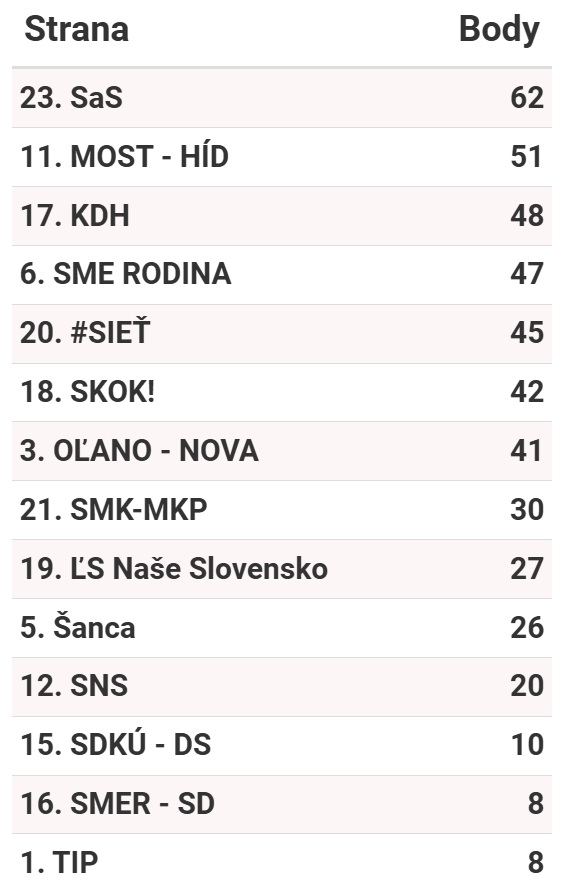
The result was a ranked list of parties with point totals, recalculated dynamically based on user-selected values. Rankings changed significantly depending on personal priorities, illustrating how political alignment is rarely absolute.
Impact & Significance
- Encouraged active reflection instead of passive consumption
- Lowered the cognitive barrier for political engagement
- Demonstrated early Slovak civic-tech experimentation
- Modeled transparency over persuasion
- Showed how subjective assumptions can be made explicit instead of hidden
The project remains archived via the Wayback Machine as a snapshot of grassroots digital civic innovation during the 2016 elections.
Key Takeaways
- Civic tools gain trust through transparency, not false neutrality
- Letting users modify assumptions increases engagement and ownership
- Showing subjectivity openly can be more ethical than claiming objectivity
- Even uncomfortable criteria deserve visibility if they shape real behavior
If you’re carrying an idea that could help defend democracy or empower citizens, get in touch — we’d love to build it with you.